What stands between the jigger and the gym?


Members of Liverpool‘s planning committee and a bunch of bins, of course
by Lisa Rand
Planning meetings are often reported like confrontations. Whether that’s residents versus developers or common sense versus bureaucracy, it’s the central drama that makes planning stories so compelling and a regular go-to for anyone, the Monitor included, reporting in the space of local democracy.
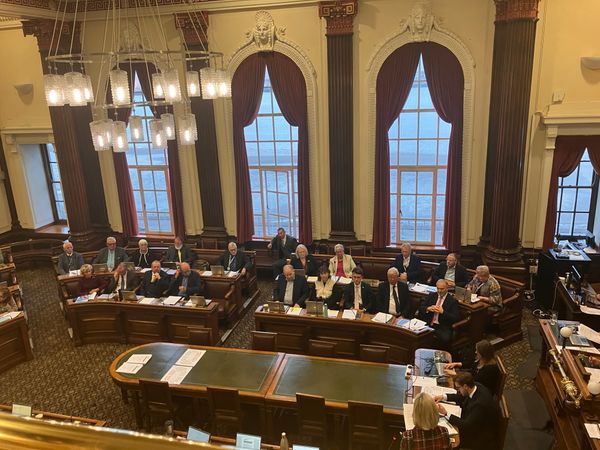
Spend any time in the council chamber, however, and they rarely feel quite so dramatic. Most planning meetings are slow, procedural, and so tightly constrained by rules that councillors have far less room to manoeuvre than the headlines might suggest.
The drama, when it does exist, is often buried in reams of documents. Whether that’s officer reports, policy clauses, financial viability assessments, bird impact studies or design and access statements, the tensions can lie there as much as in competing objections and responses by interested parties. By the time an application reaches committee, much of the real tension has already been played out on paper.
A typical planning decision involves competing pressures. At its simplest, on one side an applicant wants to build, while on the other, neighbours, businesses or campaigners may object. Officers from various council departments may also have raised concerns long before anything reaches a public meeting. Overlaying all of that is a dense framework of policy, from local plans to national guidance, and the ever present possibility of an appeal to the Planning Inspectorate if a decision goes the wrong way.
Most applications never reach committee at all. They are decided by officers under delegated powers or withdrawn when it becomes clear they‘re unlikely to succeed. Even these somewhat quieter decisions often contain the same tensions, expressed in the dry language of reports rather than in any public council chamber.
When applications do reach the planning committee, councillors are not simply there to choose what they like or dislike. They are navigating what is and isn’t defensible within those rules. Approve the wrong scheme, and it could be overturned on appeal. Refuse one without solid grounds, and the same thing can happen, and that can prove costly to the local authority in various ways.
All of which means the reality of planning decisions in the room can feel quite different from the stories told about them. It is in this gap that narratives can form, harden, and sometimes drift away from what is actually happening.
A recent example, involving a women-only gym, some bins, and a planning committee, shows just how easily that can happen.
Here at the Monitor, planning applications are a daily diet. We chew on traffic management strategies for breakfast, let landscape designs percolate like good coffee during the day, and then sometimes imagine we’re a lord in a top hat getting annoyed about brownfield land by midnight. It’s not the healthiest of diets, granted, but tasty enough as long as you don’t mind trawling through dozens of documents on the daily. Many applications are fairly unremarkable, but some do catch the eye.
Last week, during that daily digest of planning across Merseyside, the Monitor came across an application due to go before committee the following day. It involved a women-only gym in West Derby that officers were recommending to be refused, mostly due to problems around bins in an alleyway the applicant wanted to use as the entrance.
On paper, there was something almost comical about it, and it would have been easy to produce a story injecting some humour, a bit of narrative colour, about gym-goers trying to dance between bins with their kit bags. The Monitor mulled some potential headlines, but there was something buried in the documents, the information bundle councillors had before them, which gave pause - and it turned out to be well-timed.
When the application reached committee the next day, what emerged was a story of people and community, of the life-changing power of a space to belong, as well as the reality that confronts such communities when high minded ambitions meet the grind of bureaucratic reasoning.
The gym, ALMA Fitness Studio, already exists and is a hugely popular space in West Derby. It is so popular, in fact, that the owner decided it was time to expand to a bigger site. It’s a business, but one with a strong community ethos. Women-only gyms can be a lifeline for many who, for a range of reasons, find mixed spaces unsuitable. At the committee, the owner also spoke of filling a gap in public health by offering rare sessions for expectant mothers, something many gyms are unable or unwilling to accommodate due to the additional complexities involved.
As part of the application process, efforts had been made to explore alternative sites through what is known as a sequential test. The proposed new space, at Muirhead Avenue East, is a disused storage unit, which the applicant described as being overrun by rats and gradually becoming an eyesore. The gym, it was argued, could change all that.
Questions were raised about the bin arrangements and plans to use the alleyway at the back of the building as an entrance. The report used a term perhaps not often heard in these parts: ginnell. Many locally might know it instead as a jigger. For the sake of clarity, we’ll call it an alleyway.
Reading the report, one might imagine the route as difficult. In places, just 20cm of space was said to exist between bins and the wall. However, a photo submitted by the applicant suggested a more navigable passage. The possibility of creating a dedicated walkway by adjusting the layout was discussed, but officers raised practical concerns about how this could work without impacting neighbouring businesses, some of which had objected to the proposals.
Then came the moment that blew the potential comedy away and brought into focus how these committees, for all their dramatic framing in the retelling, are ultimately not so much about buildings as they are about people.
A member of staff from the gym spoke to the committee. Speaking with quiet earnestness, they described how the gym had transformed their life, giving them a safe space to grow, build confidence, and ultimately find a new and fulfilling career with the support of the owner.
It’s not possible to see inside the minds of the members of the committee in that moment of course, and the response from the chair was a simple ‘thanks’ when the woman had finished speaking, but it was an account that’s hard to imagine wouldn’t have had at least some small impact, reinforcing a sense of the importance of this gym within its community.
There followed three possible motions - reject the plans as per the officer recommendations, approve as long as something could be done about the alleyway and the bins, put forward by one councillor and subject to a mini off the mic conference between the legal bods at the council as potentially not a viable option. And then one councillor had an idea - a site visit, which was duly voted on and approved.
The site visit kicks the problem down the road a bit, of course, but the central issues remain. The officers had been adamant the alleyway problem was fairly insurmountable but the committee were not done with the application yet, so now they will head down to the jigger and perhaps do their own dance with imaginary kit bags amid the bins. They will also take a look at some of the parking and other issues mentioned in the report.
The Monitor will be keeping tabs on the outcome when it comes back to committee. But there is already a lesson to be learnt from this case about the stories we tell and how they must always be in service to the information and the people.
Get it the wrong way round and you might find yourself dancing absurdly amongst the bins. A salutary lesson indeed, perhaps, lurking between the jigger and the gym.